
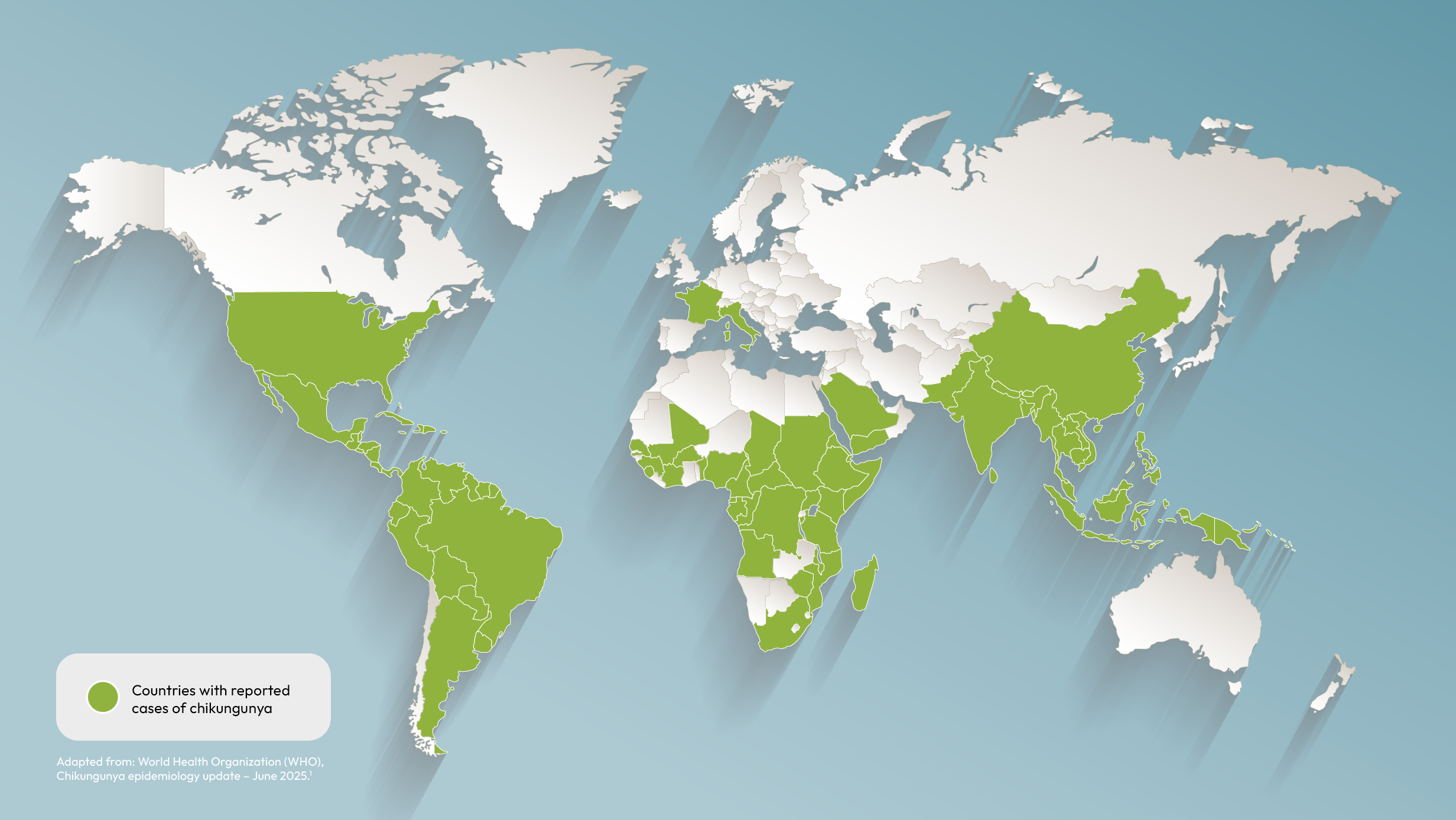
Where is chikungunya found?
Chikungunya has been found in around 120 countries.1 These include many popular travel destinations in tropical and sub-tropical places like Latin America, Africa, plus South and South-East Asia.1 Among the most visited of these are India, Mexico, Indonesia and Thailand.2,3
Chikungunya in numbers
In 2025, over 485,000 confirmed cases of chikungunya were recorded worldwide.4
Over 220 deaths were caused by chikungunya in the same year.4
Chikungunya is easy to mistake for other mosquito-borne diseases, meaning not every case is recorded.5–9 So it’s possible that number is much higher.
OVER
485,000
CONFIRMED CASES OF CHIKUNGUNYA
WERE RECORDED WORLDWIDE in 20254
OVER
220
deaths
caused by Chikungunya in 20254
How is the risk of chikungunya changing?
Over the last 50 years, chikungunya has been spreading.10 It’s been found in places that have never had chikungunya before.10–13 The outbreaks have also become bigger, more serious, and more unpredictable.1,11–13 And chikungunya doesn’t just disappear after outbreaks. It can keep spreading in mosquitoes and come back to cause more outbreaks in people.14
Global travel, climate change and changes in the chikungunya virus are all contributing to the spread of chikungunya.10,15 In recent years, we have seen outbreaks in places like Europe and the USA.11–13,16,17
Before travelling, make sure to speak with your travel health provider. They can give you the latest information about your destination.

The link below will take you to an external site not controlled by Bavarian Nordic.

Find a travel clinic
Browse travel health providers in your area.

References
1. World Health Organization. epidemiology update – June 2025. Available from: https://www.who.int/publications/m/item/chikungunya-epidemiology-update-june-2025. Accessed May 2026.
2. Office for National Statistics. Travel trends 2024. Travel trends estimates: UK residents visits abroad. August 2025. Available from: https://www.ons.gov.uk/peoplepopulationandcommunity/leisureandtourism/datasets/ukresidentsvisitsabroad. Accessed May 2026.
3. Badan Pusat Statistik. Statistik kunjungan wisatawan mancanegara 2024. Vol 16. Indonesia: Badan Pusat Statistik; 2025. Available from: https://www.bps.go.id. Accessed May 2026.
4. European Centre for Disease Prevention Control. Communicable disease threats report, 13-19 December 2025, week 51. Available from: https://www.ecdc.europa.eu/en/publications-data/communicable-disease-threats-report-13-19-december-2025-week-51. Accessed May 2026.
5. World Health Organization. Chikungunya. 2025. Available from: https://www.who.int/news-room/fact-sheets/detail/chikungunya. Accessed May 2026.
6. Salam N, et al. BMC Public Health. 2018;18:710.
7. Rico-Mendoza A, et al. Rev Panam Salud Publica. 2019;43:e49.
8. Shukla A, et al. J Trop Pediatr. 2021;67(3):fmaa053.
9. Faria BS, et al. Braz J Infect Dis. 2024:28(3):103747.
10. McGuinness SL, Wu HM. Pretravel Considerations for Non-vaccine-Preventable Travel Infections. In: Travel Medicine (Fourth Edition). 2019;53–60.
11. Yactayo, S et al. J Infect Dis. 2016;214(5):S441–S445.
12. European Centre for Disease Prevention and Control. Factsheet about chikungunya. Available from: https://www.ecdc.europa.eu/en/chikungunya/facts/factsheet. Accessed May 2026.
13. European Centre for Disease Prevention and Control. Chikungunya fever in EU/EEA. Available from: https://www.ecdc.europa.eu/en/chikungunya/threats-and-outbreaks/chikungunya-fever-eueea. Accessed May 2026.
14. Silva LA, Dermody TS. J Clin Invest. 2017;127(3):737–749.
15. Bartholomeeusen K, et al. Nat Rev Dis Primers. 2023;6;9(1):17.
16. The World Mosquito Program. Chikungunya Fact Sheet. Available from: https://www.worldmosquitoprogram.org/sites/default/files/2019-11/WMP%20chikungunya.pdf. Accessed May 2026.
17. Fischer D, et al. Int J Health Geogr. 2013;12:51.
UK-CHIK-2600048 | May 2026