
Where is chikungunya found?
Chikungunya has been reported in 119 countries, including many popular travel destinations in tropical and subtropical places like Latin America, Africa, plus South and Southeast Asia.1
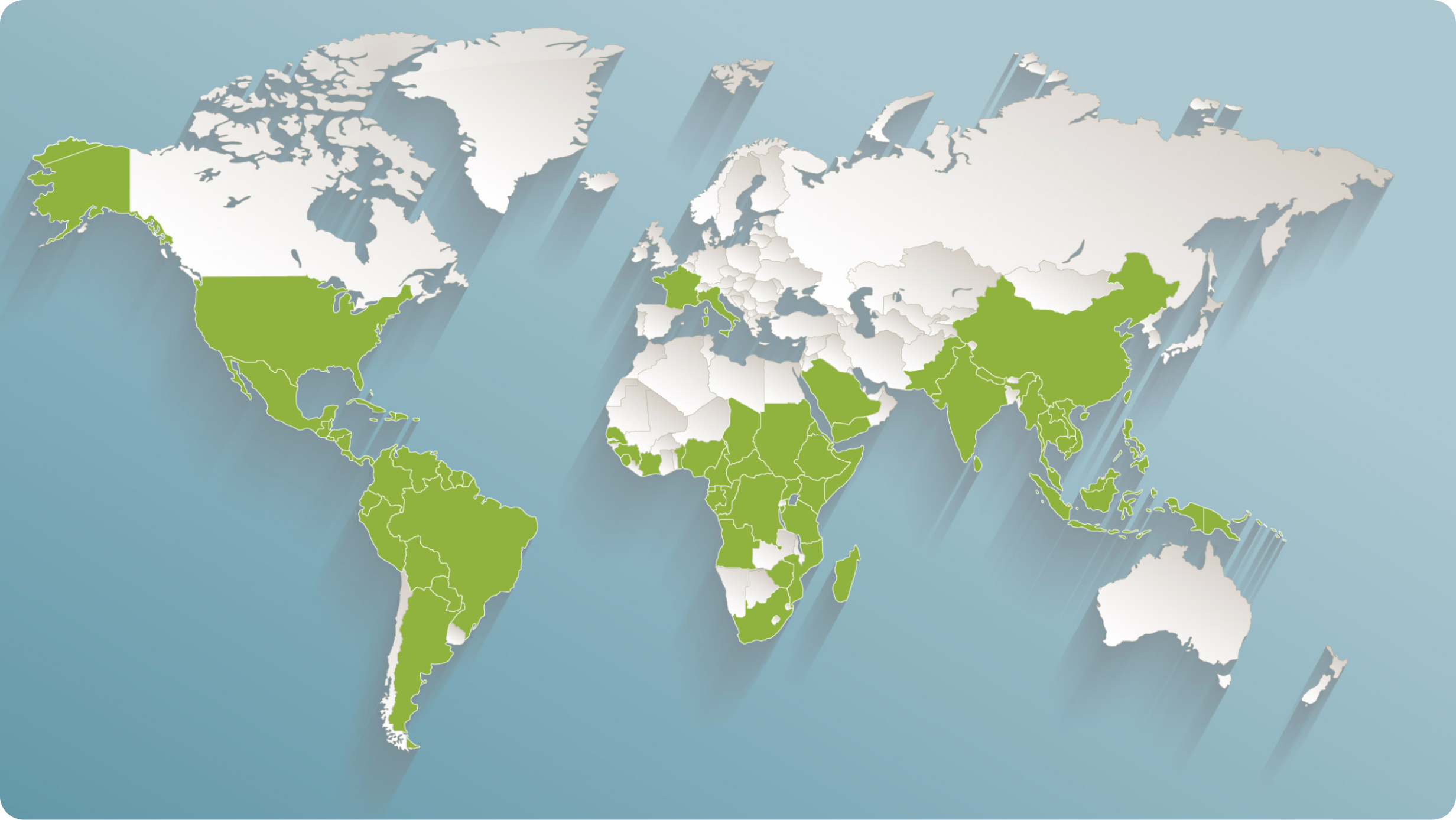
World Health Organization (WHO). Global distribution of chikungunya.
Chikungunya in numbers
In 2024, over 620,000 confirmed cases of chikungunya were recorded worldwide.2–4
213 deaths were caused by chikungunya in the same year.2–4
Chikungunya is easy to mistake for other mosquito-borne diseases, meaning not every case is recorded.2,5–8 So it’s possible that number is much higher.
OVER
620,000
CONFIRMED CASES OF CHIKUNGUNYA
WERE RECORDED WORLDWIDE in 20242-4
213
deaths
caused by Chikungunya in 20242-4
How is the risk of chikungunya changing?
Over the last 50 years, chikungunya has been spreading.9 It’s been found in places that have never had chikungunya before.9-12 Chikungunya outbreaks are frequent, unpredictable, and widespread.2,10-12
The growth of cities, global travel, and changes in the chikungunya virus are all contributing to the spread of chikungunya.9,13
In recent years, we have seen outbreaks in places like Europe and the USA.10-12,14,15

My chikungunya story
Lorren shares his experience with the long-term effects of chikungunya. Watch his story here.


1. Chikungunya epidemiology update – June 2025. World Health Organization. Accessed July 21, 2025. https://www.who.int/publications/m/item/chikungunya-epidemiology-update-june-2025
2. Chikungunya. World Health Organization. Updated April 14, 2025. Accessed October 9, 2025. https://www.who.int/news-room/fact-sheets/detail/chikungunya
3. Chikungunya virus disease worldwide overview. European Centre for Disease Prevention and Control. Updated January 2024. Accessed February 2025. https://www.ecdc.europa.eu/en/chikungunya-monthly
4. Chikungunya virus disease – global situation. World Health Organization. Accessed July 2024. https://www.who.int/emergencies/disease-outbreak-news/item/2024-DON518
5. Salam N, et al. Global prevalence and distribution of coinfection of malaria, dengue and chikungunya: a systematic review. BMC Public Health. 2018;18(1):710.
6. Rico-Mendoza A, et al. Co-circulation of dengue, chikungunya, and Zika viruses in Colombia from 2008 to 2018. Rev Panam Salud Publica. 2019;43:e49.
7. Shukla A, et al. Long-term neurodevelopmental outcomes of neonatal chikungunya: follow-up of a series of cases till 1 year. J Trop Pediatr. 2021;67(3):fmaa053.
8. Faria BS, et al. Vertical transmission of chikungunya virus: a worldwide concern. Braz J Infect Dis. 2024;28(3):103747.
9. McGuinness SL, Wu HM. Pretravel considerations for non-vaccine-preventable travel infections. In: Travel Medicine (Fourth Edition). 2019;53–60.
10. Yactayo S, et al. Epidemiology of chikungunya in the Americas. J Infect Dis. 2016;214(suppl 5):S441–S445.
11. Factsheet for health professionals about chikungunya virus disease. European Centre for Disease Prevention and Control. Accessed October 9, 2025. https://www.ecdc.europa.eu/en/chikungunya/facts/factsheet
12. Chikungunya fever in EU/EEA. European Centre for Disease Prevention and Control. Accessed October 9, 2025. https://www.ecdc.europa.eu/en/chikungunya/threats-and-outbreaks/chikungunya-fever-eueea
13. Bartholomeeusen K, et al. Chikungunya fever. Nat Rev Dis Primers. 2023;9(1):17.
14. Chikungunya fact sheet. The World Mosquito Program. Accessed October 9, 2025. https://www.worldmosquitoprogram.org/sites/default/files/2023-08/WMP%20chikungunya.pdf
15. Fischer D, et al. Climate change effects on chikungunya transmission in Europe: geospatial analysis of vector’s climatic suitability and virus’ temperature requirements. Int J Health Geogr. 2013;12:51.